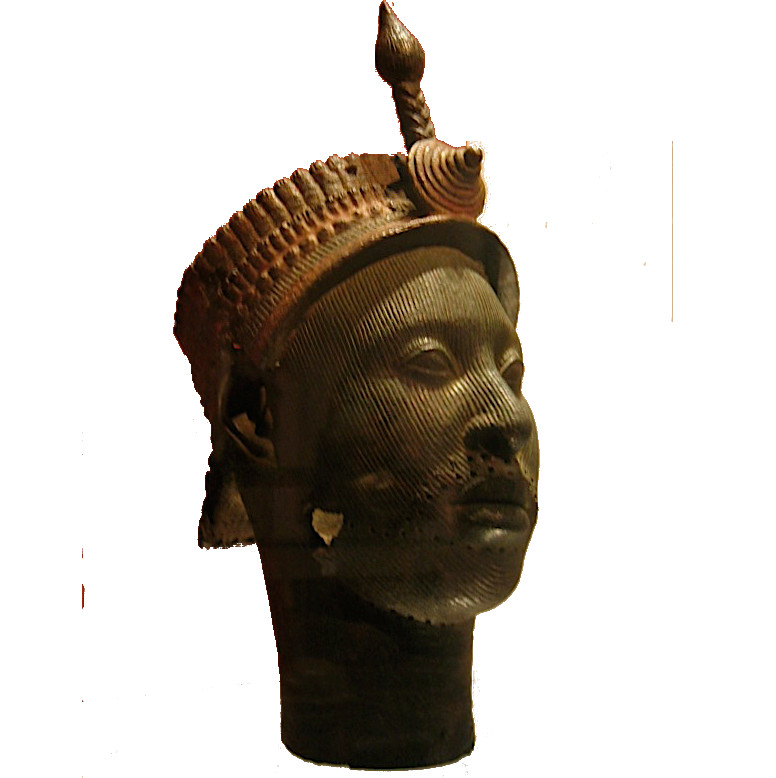
Featured photograph: the Ife Head, British Museum. Photograph by Sailko; cutout by Victuallers, via Wikimedia Commons, CC BY-SA 3.0. Reused without further editing. This is not a still from the DW documentary.
The story of Ile-Ife is about more than remarkable sculptures. It is about technological knowledge, trade, historical prejudice and the responsibility to understand and protect our heritage.
In 1910, the German explorer Leo Frobenius encountered the remarkable portrait sculptures of Ile-Ife. Rather than accepting them as the achievements of an African society, he connected them to the mythical lost civilization of Atlantis. The artworks challenged his understanding of Africa, but his explanation placed their origins somewhere else. Source: DW’s programme description.
That encounter raises a question that remains worth asking: What happens when the evidence in front of us is stronger than the assumptions we bring to it?
DW’s documentary, Nigeria’s Mysterious Art Treasures, brings renewed attention to Ile-Ife through its sculptures, archaeological remains and glassmaking industry. Its subject is not simply a collection of beautiful objects, but the society that produced them and the unresolved questions surrounding its transformation. Source: DW.
For Nigeria, this history deserves more than a moment of admiration. It should encourage a deeper conversation about knowledge, creativity and what we choose to preserve.
When Prejudice Stood in the Way of Understanding
The problem with colonial-era interpretations of Ife’s art was not a lack of appreciation for its beauty. It was the difficulty some observers had in accepting who created it. The British Museum acknowledges that Western scholars wrongly explained the Ife heads through Classical influence or European production, rather than recognizing their African origins. Source: British Museum, “The Ife Head.”
There is a serious lesson here about how prejudice works. Evidence can be admired and still be misunderstood. A person may recognize the quality of an object while refusing to recognize the ability of its maker.
But correcting that injustice requires more than reversing the direction of praise. African art should not need to resemble Greek sculpture or European portraiture before it is considered important. Realistic representation is one artistic achievement, not the only measure of artistic value.
The more useful questions concern the artists themselves. What did they want to communicate? How did they learn their craft? Who supported their work? What did these objects mean to the communities that commissioned, used and preserved them?
The story becomes richer when its centre shifts from the surprise of an outsider to the knowledge and intentions of the people who made the work.
Behind the Beautiful Faces Was Technical Knowledge
The famous Ife heads invite close attention to their carefully modelled faces and intricate surface details. Their materials also deserve attention. The British Museum identifies its celebrated Ife head as brass—a copper alloy—and records that it was produced using the lost-wax casting technique. The familiar label “bronzes” therefore does not precisely describe the material of every object associated with this tradition. Source: British Museum, “Head of a ruler, Ife,” published by Smarthistory.
That distinction is not merely a technical correction. It reminds us that an artwork is also the outcome of a manufacturing process.
A finished sculpture invites admiration, but it should also prompt questions about mould-making, material selection, heat control and finishing. These are questions about learned skills and practical decisions, not simply inspiration.
The same perspective changes how we look at less spectacular remains. Archaeologist Gérard Chouin has described Ife’s potsherd pavements, in which pottery fragments were placed vertically, as a practical way of creating small drainage channels during the rainy season. Source: William & Mary, 2015.
A royal portrait and a paved courtyard may seem to belong to different worlds. One attracts attention in a gallery; the other helps people move through an inhabited space. Yet both invite us to examine how knowledge was applied to materials and everyday needs.
An adequate history of Ife should make room for both.
The Glass Beads That Reveal a Larger Story
One of the most important findings associated with Ile-Ife concerns objects small enough to overlook: glass beads.
Research at Igbo Olokun, involving Nigerian archaeologist Abidemi Babatunde Babalola and his colleagues, has provided evidence of a distinctive glass-production tradition. Their study published in Antiquity places the principal glassworking activity investigated at the site between the eleventh and fifteenth centuries. The researchers concluded that the technology was largely independent of glassmaking traditions documented farther afield. Source: Babalola and colleagues, Antiquity, 2017.
A related study reported the recovery of more than 12,000 glass beads and substantial production debris. Chemical analysis of 52 beads identified distinctive compositions that helped researchers investigate the materials and processes used at the site. Source: Babalola and colleagues, Journal of Archaeological Science, 2018; open-access record at Rice University.
The crucial distinction is between making objects from imported glass and making the glass itself.
Both activities require skill, but they tell different technological stories. Reheating imported material demonstrates glassworking. Producing glass from raw ingredients demonstrates an additional level of knowledge about materials and their transformation. The significance of the Ife research is its evidence for an indigenous glassmaking industry, not merely the reshaping of imported products. Source: Rice University, 2025.
For anyone interested in science or engineering, this is especially compelling. The beads invite questions about the selection of ingredients, the management of production conditions and the ability to repeat a process successfully.
They also challenge the narrow habit of separating “traditional craft” from “technology.” A useful question is not whether a practice looks modern, but what its practitioners understood and were able to accomplish.
The lesson is not that medieval glassmaking was identical to a modern industrial process. It is that the history of technology should take locally developed practical knowledge seriously.
Innovation Did Not Require Isolation
Recognizing Ife’s originality should not lead to another misleading story: that its achievements mattered only because they developed without contact with anyone else.
The glass research points to connections as well as local production. The distribution of related glass compositions elsewhere in West Africa, together with evidence of other glass types at sites within Ife, supports an interpretation of participation in regional and interregional exchange. Source: Babalola and colleagues, 2018.
Local creativity and wider connections are not opposites. A community can produce its own materials, import other goods and exchange ideas without losing ownership of its achievements.
That is a more convincing way to understand Ife than imagining either a passive society receiving everything from outside or an isolated society inventing everything alone.
There is also a reason to be careful with sweeping economic claims. Establishing that a place manufactured and distributed valuable products does not automatically establish a monopoly. Exclusive control of production or trade would require additional evidence about competitors, institutions, geographical reach and the period involved.
This caution does not diminish the glassmakers’ achievement. It helps us describe that achievement accurately.
Historical pride becomes stronger, not weaker, when it can withstand careful questions.
What Happened to Medieval Ife?
The documentary also raises the difficult question of decline. DW’s description places the beginning of this process around 1400 and identifies a major plague epidemic as one debated explanation. Source: DW.
Researchers associated with the GlobAfrica project have explored whether evidence of abandonment at Ife could reflect a severe health crisis. Their account presents plague as a possible explanation and discusses the need for further investigation, including the search for ancient pathogen evidence. Source: CNRS, “The Thousand and One Connections of Medieval Africa.”
This is a legitimate and important research question. It is not, however, the same as a settled verdict.
Evidence that people left a settlement does not, by itself, tell us why they left. Even identifying disease would leave further questions about its extent, timing and relationship to political or economic changes.
The same care is needed when discussing later Atlantic trade and European involvement. Where a proposed chronology places the beginning of decline before later disruptions, those later events cannot alone explain its onset. Different stages of change need to be examined separately rather than compressed into one dramatic explanation.
There is no need to choose between denying external disruption and making it the explanation for everything. The task is to establish what happened, when it happened and how different pressures interacted.
It is equally important not to confuse a change in political or economic fortunes with the disappearance of a people. Ife’s enduring cultural and religious significance is part of the historical account, not an afterthought to a story of lost prosperity. Source: William & Mary.
Pride Without Exaggeration
Ife’s achievements are substantial enough to stand without inflated claims.
For example, describing it as the first major city in all of sub-Saharan Africa is too sweeping. UNESCO documents a much earlier settlement history at the Old Towns of Djenné in Mali, including the archaeological site of Djenné-Djeno, with occupation extending back to the third century BCE. Source: UNESCO World Heritage Centre, Old Towns of Djenné.
We do not need to establish that Ife was first in everything before recognizing its importance.
Nor should celebrating its Yoruba heritage become a competition with the histories of other Nigerian communities. The appropriate response to an important discovery is curiosity, not a ranking of peoples.
A Yoruba achievement can be appreciated in its full cultural specificity while also being valued as part of Nigerian, African and world history. Those forms of recognition strengthen one another.
The aim should be neither to repeat old prejudices nor to replace them with comforting exaggerations. It should be to build an account that is both respectful and well supported.
What Nigeria Should Do With This Knowledge
The most useful response to Ife’s history is not simply to declare that our ancestors were great. It is to ask what responsibilities follow from knowing more about their achievements.
Education is an obvious place to begin. Students should encounter this history through more than the names of rulers or pictures of famous objects. A glass bead can introduce a discussion about materials. A pavement can raise questions about drainage and design. An excavation can demonstrate how evidence is collected, dated and interpreted.
History teaching should also explain uncertainty. Students can learn to distinguish an observed finding from an explanation proposed to account for it. That would make the subject a training ground for careful thinking rather than an exercise in memorizing confident statements.
Museums, in turn, should help visitors understand the human work behind the objects. An exhibition can ask how something was made, how it was used and what remains unknown. It should acknowledge the contributions of local custodians, Nigerian researchers and international collaborators without reducing the story to the arrival of an outsider.
Research should also reach the communities whose histories it investigates. Babalola has emphasized public engagement and identified unanswered questions about relationships among Ife’s craftspeople and the movement of materials and ideas between different crafts. That is a reminder that this field remains active, rather than a completed story waiting only to be celebrated. Source: Rice University, 2025.
Protecting archaeological sites should be part of that commitment. Before development proceeds in historically important areas, there should be a serious opportunity to assess what may be lost. Preservation need not mean rejecting modern life; it means treating irreplaceable evidence as something worth considering in planning decisions.
The people who live alongside these sites should have a meaningful role in those decisions. Heritage should not become something discussed internationally while local communities remain excluded from its interpretation or benefits.
The Most Important Treasure Is What We Learn
The contrast at the heart of this story is revealing. Frobenius looked at Ife’s art and reached for Atlantis. The archaeological research discussed here instead asks what the surviving materials can tell us about production, exchange and human choices. Source: DW’s programme description.
One approach tried to make the evidence fit an inherited assumption. The other allows evidence to revise the account.
That distinction should guide how we respond today. We should not need an exaggerated past to feel confident about the future. Neither should we accept interpretations that deny people credit for what they demonstrably achieved.
Ife’s history offers a reason to value skilled work, support research and make room for curiosity. It also challenges us to turn cultural appreciation into practical responsibility.
The best tribute to the makers of Ife is not only to admire what they left behind. It is to protect the evidence, understand their work and give the next generation the opportunity to create achievements of its own.
Source note: The discussion of DW’s documentary is based on its published programme description, not a scene-by-scene review of the complete film. The historical analysis draws on the archaeological research and institutional sources linked throughout. The plague explanation is presented as a debated hypothesis, not an established cause of decline.
Watch the DW documentary on YouTube. For the glassmaking research, see the open-access research record at Rice University.


Leave a comment