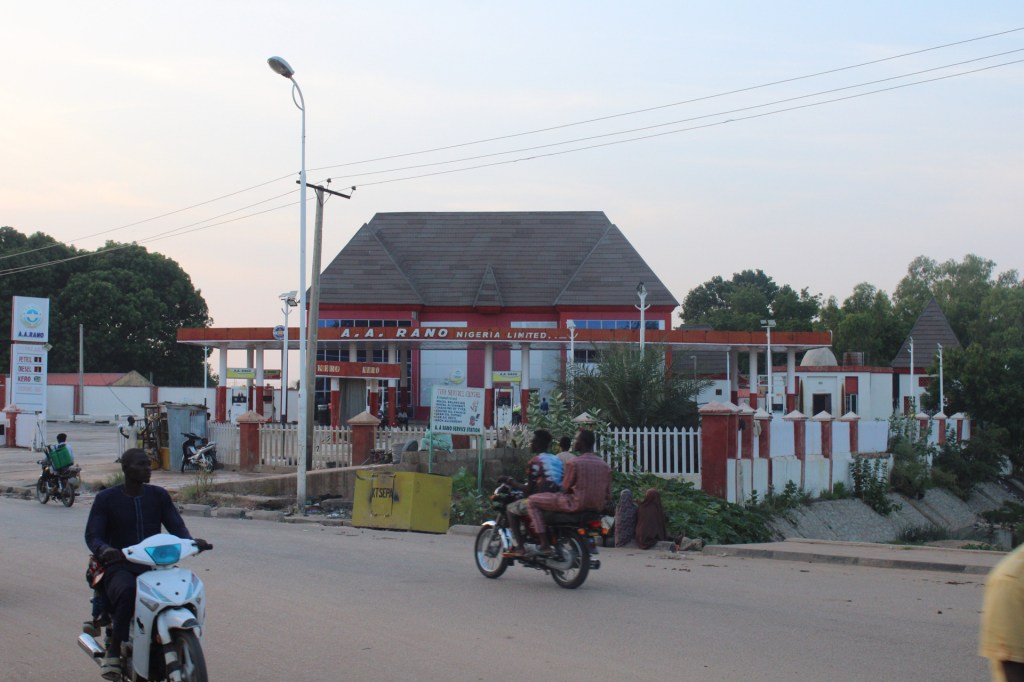
Featured photograph: A A Rano filling station, Katsina, 19 August 2021. Uncle Bash007 / Wikimedia Commons, CC BY-SA 4.0. An archive image, not a photograph of the 2026 debate.
Fuel subsidy is a question about household budgets, public money and the responsibilities of government. Examining it through party loyalty alone leaves the most important questions unanswered: who benefits, who pays, and what can be independently verified?
Policy analysis | Public statements and reports reviewed through 3 October 2026.
The renewed debate about Nigeria’s petrol subsidy is often presented as a contest between defending reform and restoring relief. That framing leaves out several distinctions. Supporting removal is not the same as approving every part of its implementation. Calling for help is not necessarily a proposal to recreate the old subsidy system. And changing a position does not, by itself, reveal why someone changed it.
There is a factual starting point. Before and shortly after the 2023 election, Bola Tinubu, Atiku Abubakar and Peter Obi publicly supported ending the existing petrol-subsidy arrangement, although their statements differed on implementation and accompanying measures. The contemporary record is set out below. Their more recent proposals now require distinctions that a simple “for or against subsidy” label cannot capture.
A national issue—not a test of party loyalty
There are two different meanings of “politicising” a national issue. One is democratic debate: representatives disagree about spending, taxation and the distribution of costs. Those choices belong in public discussion. The other is partisan treatment: accepting or rejecting a claim because of the person or party making it, rather than examining its evidence.
The distinction matters here. A demand for audited accounts is not an attack on the nation. Concern about the cost of a subsidy is not proof of indifference to poverty. A complaint about rising living costs is not answered simply by identifying the complainant’s political affiliation.
Moving beyond partisanship does not mean silencing disagreement. It means keeping the standard of evidence unchanged when the speaker changes. The same questions about cost, delivery and accountability apply to an existing government programme and to a proposed replacement.
What the 2023 record actually shows
At his manifesto launch in October 2022, Tinubu proposed phasing out the fuel subsidy and redirecting resources to areas including welfare, transport, roads, education and healthcare. That was a campaign commitment, not an audited account of what subsequently happened. Source: Reuters, October 2022.
At a Lagos Business School event on 15 November 2022, Atiku said he would remove the subsidy and channel the funds back into the economy. His support for removal was explicit. Source: TheCable, 15 November 2022.
Following the May 2023 removal announcement, Obi reaffirmed his support for ending the subsidy but said he would have introduced measures to cushion the impact. His statement on 6 June 2023 distinguished the policy’s objective from how the transition was handled. Source: Channels Television, 6 June 2023.
There was therefore an area of agreement, not proof of identical plans. Criticism of the timing, preparation or protection accompanying removal cannot automatically be counted as a reversal of support for removal itself.
The positions now being put forward
Tinubu: retaining the reform
In his 1 October 2026 Independence Day address, Tinubu ruled out returning to the petrol-subsidy regime. He acknowledged that the reforms had difficult effects while arguing that they addressed longstanding economic weaknesses. He also cited improvements in economic indicators as part of his defence. These are the administration’s stated arguments; an assessment of particular outcomes requires the underlying data and the period being compared. Source: Punch, 1 October 2026.
The relevant questions extend beyond whether removal remains government policy: what protection reached affected households, what changed in public finances, and how those changes translated into services and purchasing power.
Atiku: support for domestic production
In a statement reported on 11 September 2026, issued through his spokesperson Phrank Shaibu, Atiku described a production-subsidy model. It would reduce crude-input costs for qualifying Nigerian refineries rather than subsidise imported products. The stated safeguards included a fiscal ceiling, a maximum amount of support per barrel, tracking, verification, domestic supply obligations and audits. Additional consumer support, he said, would be funded openly through the budget. Source: Punch, 11 September 2026.
This is a different mechanism from simply reviving the former arrangement. The report, however, does not provide a numerical ceiling or a complete costing. Further analysis would need those figures, the financing assumptions, and evidence of how lower input costs would reach consumers. A producer receiving support and a household receiving relief are not necessarily the same thing.
Obi: different statements on restoration
On 24 August 2026, at the Nigerian Bar Association conference in Port Harcourt, Obi maintained that the subsidy needed to be removed and that alleged mismanagement of the proceeds was not a reason to reverse removal. Source: Channels Television, 24 August 2026.
At a Sokoto town hall on 28 September 2026, he instead linked tackling corruption to bringing back subsidy: “By removing the corruption, I assure you that we will bring back subsidy.” Source: TheCable, reporting the News Agency of Nigeria, 28 September 2026.
The two dated statements express different positions on restoration. They do not, on their own, establish the reasons for the change or the full design of a future programme. Those questions require clarification, including which costs would be covered, for whom, for how long, and from what revenue.
For all three positions, there is a difference between documenting what was said and deciding whether a policy will deliver its intended effects. A speech establishes a stated commitment; it does not substitute for a budget, implementation plan or independently measured result.
Household hardship and fiscal improvement can coexist
The World Bank’s April 2026 Nigeria Development Update described stronger macroeconomic stability, easing inflation and improved fiscal and external positions. It also reported that household incomes had not fully recovered and that poverty remained high. Its account does not present better national indicators and continuing household hardship as mutually exclusive. Source: World Bank, April 2026 edition.
The IMF’s June 2026 assessment similarly distinguished improved macroeconomic outcomes from difficult living conditions and identified international fuel and food shocks as sources of pressure. These assessments concern a broader economic programme and external conditions—not the isolated effect of one policy. Source: IMF, 9 June 2026.
There is also a simple arithmetic distinction between lower inflation and lower prices. In an illustrative example, a basket rising from ₦100 to ₦150 and then to ₦165 has experienced a fall in inflation from 50 per cent to 10 per cent. Yet it still costs 65 per cent more than at the beginning. An income that has not kept pace will buy less.
That is why a national economic assessment and a family’s account of its own budget can describe different aspects of the same situation. Neither automatically disproves the other. The measurement questions are whose income, which prices, what period, and what assistance actually reached the household.
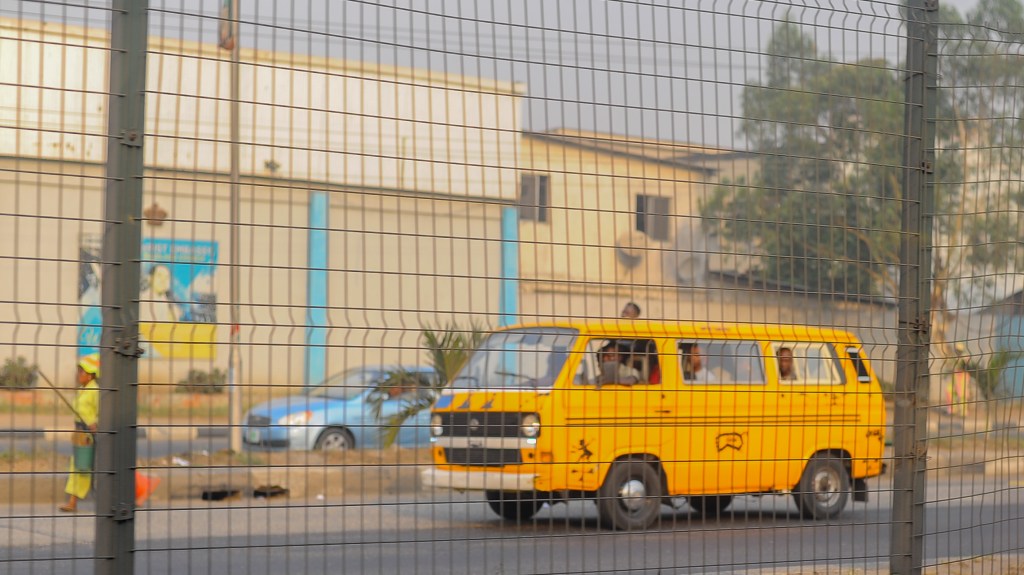
The word “subsidy” does not describe one policy
A broad petrol-price subsidy, support for selected refineries, a household cash transfer and assistance for bus passengers operate through different channels. Calling all of them “relief” does not make their beneficiaries, costs or delivery risks identical.
The IMF’s explanation of energy subsidies identifies poor targeting as a recurring problem: wealthier households generally consume more energy and receive a larger share of direct benefits. It also describes the potential pressure on budgets and other public spending. This is a general finding, not a newly calculated estimate of Nigeria’s 2026 distribution of benefits. Source: IMF, energy-subsidy overview.
That does not mean households without cars are unaffected by petrol prices. In June 2023, the World Bank warned of the reform’s impact on Nigerian households and emphasised compensating support. The distribution of direct fuel purchases is therefore only part of the welfare question; the effects on essential spending and household coping decisions also matter. Source: World Bank, 27 June 2023.
There are different implementation questions for each mechanism. For cash support, who qualifies and who might be excluded? For transport assistance, does support reduce fares or improve services? For a refinery discount, how much reaches the pump price? For a price ceiling, who absorbs a widening gap between supply costs and the price paid by the customer?
These questions allow comparison without assuming that a programme is effective because it is called compassionate, or ineffective because it is called a subsidy.
What corruption control can—and cannot—change
Two costs need to be separated: payments that should never have been made, and the legitimate cost of the support a programme promises. Preventing false claims can reduce the first. It does not necessarily eliminate the second.
The International Energy Agency’s price-gap approach measures consumption support using the difference between a reference supply price and the price paid by consumers, multiplied by the quantity consumed. That provides a useful way to illustrate the arithmetic, although it is not a full costing method for every form of producer support. Source: IEA, subsidy methodology.
An illustration—not a forecast or a candidate’s costing
Assume, purely for illustration, eligible consumption of 40 million litres a day and public support of ₦100 per litre.
₦100 × 40,000,000 × 365 = ₦1.46 trillion a year.
At an assumed ₦300 per litre, with the same volume, the annual amount would be ₦4.38 trillion, before administration and financing costs.
Neither the volume nor the support rate is presented as a current Nigerian measurement. These calculations are not estimates of Atiku’s, Obi’s or the government’s proposals.
Even with no fraudulent claims, the assumed price gap has a cost. Conversely, that example does not establish that every possible subsidy would cause a fiscal crisis. A funded, limited intervention and an unlimited commitment are different obligations. Their affordability depends on the amount, duration, available revenue and competing commitments.
Domestic refining does not make the input cost disappear
Domestic production and the valuation of crude are separate questions. As the IEA explains, an exporting country can incur an opportunity cost when it supplies energy below the value obtainable elsewhere, even without making an equivalent cash payment. Discounted crude can therefore involve public revenue forgone. Source: IEA, treatment of energy-exporting economies.
For any such arrangement, the useful evidence would show the discount’s value, the eligible volumes, the participating producers, and the reduction actually passed to buyers. A lower input bill alone does not establish an equal reduction in the retail price. Nor does changing the currency of settlement, by itself, remove the underlying value of the crude.
This is not a conclusion for or against a particular production scheme. It identifies the transactions that need to be measured before its public cost and consumer benefit can be compared.
Following the money after removal
The accounting questions apply to removal as well as restoration. In December 2023, the World Bank called for clearer information about NNPCL revenues, subsidy arrears and the effect of reform on Federation revenues. That was a dated transparency recommendation—not evidence that every subsequent account is missing or that all reported gains are fictitious. Source: World Bank, 13 December 2023.
There is a basic distinction between avoiding an expense and receiving an equivalent new cash deposit. Avoided spending may reduce borrowing, release resources for other spending, or help settle existing obligations. These possibilities have different meanings for a public account.
A comparison also needs to separate nominal amounts from purchasing power. More naira allocated to a service does not automatically mean more medicines, more maintained roads or more teaching materials if their costs have increased. Equally, an improvement cannot be dismissed solely because it did not take the form of a cash payment to every citizen.
The World Bank’s October 2025 recommendations included greater transparency over Federation Account deductions, better public-spending outcomes and regular social support. Those recommendations also show why the discussion extends beyond the presidency: the use of shared public revenues involves more than one level of government. Source: World Bank, 8 October 2025.
The evidence that makes different proposals comparable
A common set of questions can organise this debate without assigning a winner or assuming that all proposals have equal evidence behind them.
What exactly is being promised? A lower pump price, discounted crude, a cash transfer, a transport service and an infrastructure investment are different deliverables. The intended recipients and eligibility conditions need to be identifiable before delivery can be checked.
What is the full cost, and who finances it? A comparable account includes budget payments, revenue forgone, administration and financing. For a new programme, it can show the funding source and the effect of higher oil prices, exchange-rate movements or larger volumes. For an existing programme, it can compare allocations with actual expenditure.
What reaches the public? A programme’s label is not its outcome. Household payments can be examined against eligibility and payment records; transport support against services and fares; production support against verified output and consumer prices. Each mechanism needs measures suited to what it claims to deliver.
What happens when assumptions change? A spending cap, review date, complaints process and published audit establish different information from an open-ended promise. The same inquiry applies to protection offered during subsidy removal: its coverage, timeliness and purchasing power can be examined rather than presumed.
These questions do not remove value choices. People may reasonably place different weight on immediate relief, debt exposure, administrative feasibility and investment in public services. Clear evidence makes those disagreements intelligible; it does not make the decision on their behalf.
Keeping the national interest in view
The issue is not whether citizens are allowed to disagree about subsidy removal. They are. The distinction is between a disagreement about measurable consequences and a disagreement reduced to political identity.
Past support for a policy does not prove that its implementation was adequate. A later change of position does not establish that the replacement is workable—or reveal the speaker’s private motives. An improvement in public finances does not tell the whole household story, and an account of hardship does not, by itself, calculate the cost of a remedy.
That is why a national issue loses clarity when every criticism is treated as sabotage and every defence as a denial of suffering. Accountability can run in both directions: explaining the results of policies already implemented and providing the evidence behind alternatives being proposed.
The questions remain the same regardless of the party in office: who benefits, who pays, what is delivered, and what can the public verify? Those questions leave room for democratic disagreement while keeping the discussion centred on people’s lives rather than partisan labels.
About the evidence: Links beside factual claims identify the underlying reports. Political statements are presented as stated positions, not as proof that a proposal has been funded or implemented. Economic assessments retain their publication dates; the numerical examples are hypothetical. The photographs are archival and carry separate Creative Commons licences. No endorsement by their photographers or the people or businesses depicted is implied.
Earlier on Brymo’s Take: Nigeria at a Crossroads: Subsidy and Exchange Rate (February 2024). To flag an error or provide a relevant source, use the Contact page.


Leave a comment