
Sudan, a country long burdened by military coups, ethnic tensions, and broken promises, is once again in the grips of a devastating civil war. This time, the stakes are higher, the suffering deeper, and the world’s attention woefully lacking.
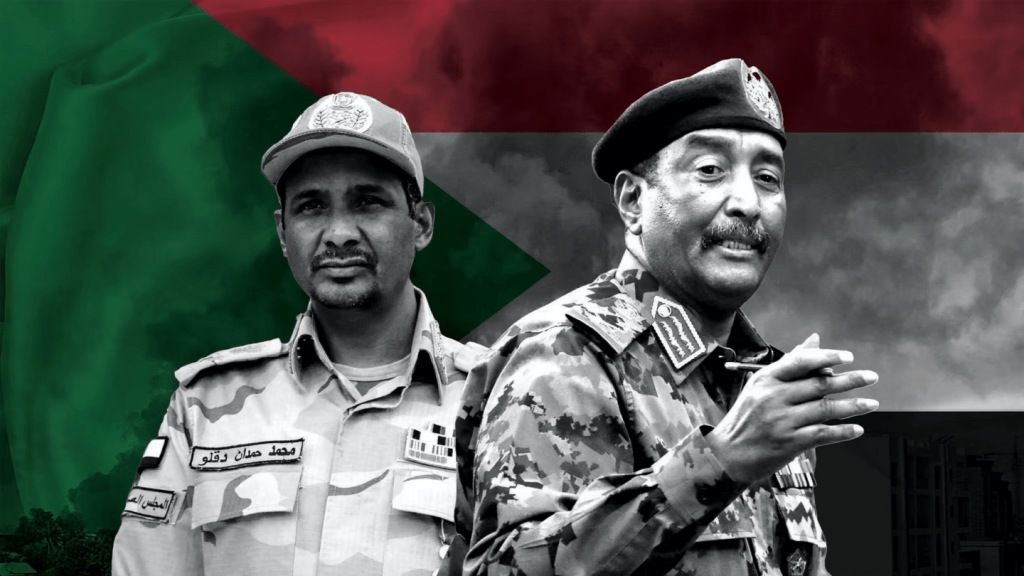
Image source (Financial Times)
A Nation Built on Fragile Foundations
Since its independence in 1956, Sudan’s history has been a story of power struggles and betrayal. Omar al-Bashir’s brutal 30-year dictatorship was marked by mass atrocities, particularly the Darfur genocide of the early 2000s, where over 3,000 villages were destroyed, and hundreds of thousands killed. To consolidate his grip on power, Bashir cunningly balanced the national army (Sudanese Armed Forces, SAF) against the paramilitary Rapid Support Forces (RSF), originally formed from the notorious Janjaweed militias.
However, the seeds of today’s war were planted when the 2018 economic crisis sparked widespread protests, leading to Bashir’s downfall in 2019. The Sudanese people’s dream of democracy seemed within reach.
Betrayal of a Revolution
The toppling of Bashir was supposed to usher in a civilian-led government. Instead, two men—General Abdel Fattah al-Burhan (SAF) and Mohamed Hamdan Dagalo (Hemedti) (RSF)—seized power. Initially allies, their partnership quickly deteriorated into rivalry as both vied for ultimate control.
A power-sharing deal in 2019 promised a transition to democracy within 39 months. But in 2021, Burhan led a coup that dismantled the transitional council, crushing civilian hopes. Plans to integrate the RSF into the army further strained relations, ultimately sparking full-scale war in April 2023.
Generals at War: Burhan vs. Hemedti
Burhan controls the conventional military, backed by air superiority and established institutions. Hemedti, funded by Sudan’s lucrative gold trade and alliances with foreign powers like the UAE, commands around 100,000 RSF fighters, many of whom are veterans of Darfur’s brutal conflicts.
Both generals have exploited ethnic and economic divisions for their benefit. RSF forces, predominantly Arab militias, have resumed genocidal campaigns against non-Arab communities in Darfur, with towns like El-Geneina witnessing mass killings of up to 15,000 people.
Meanwhile, in the capital Khartoum, SAF forces have slowly regained ground, recently retaking strategic sites like the Khartoum International Airport. Yet, the country remains deeply fractured.
A Humanitarian Catastrophe Unfolds
The war has displaced over 12 million people, creating the largest displacement crisis in the world today. More than 25 million Sudanese urgently need aid, with 18 million facing severe hunger. Famine conditions have been declared in parts of Darfur and Al Fasher, where 1.8 million civilians are trapped.
Aid efforts are crippled by both warring sides looting or blocking humanitarian deliveries. Small clinics and grassroots organizations, like those in the Nuba Mountains, struggle heroically to care for the wounded and starving, but resources are dwindling. With only one doctor for every 4 million people in some areas, desperation is growing.
In refugee camps, survivors eat rats and leaves to stave off starvation. Children, especially, are vulnerable, with 17 million now out of school, putting them at risk of trafficking, slavery, and abuse.
Global Powers and Local Suffering
While Sudan bleeds, global powers play a silent but deadly role behind the scenes. The UAE, Russia, and Saudi Arabia reportedly supply weapons and funding to the RSF, while Egypt and Iran back the SAF. The lure of Sudan’s gold and strategic Red Sea ports outweighs any real commitment to peace.
International diplomacy has so far failed. Ceasefire talks falter amid deep mistrust, and the world’s focus remains fixated on other crises. The UN’s $2.7 billion humanitarian appeal remains woefully underfunded.
Stories of Survival and Hope
Amid the carnage, glimmers of resilience shine through. Local youth-led Emergency Response Rooms (ERRs) organize evacuations and distribute food under constant threat. Boarding schools like Our Father’s Cleft in the Nuba Mountains provide shelter and education for hundreds of children, shielding them from the horrors of war.
Healthcare workers like Dr. Tom Catena continue to serve in impossible conditions, treating thousands with barely any supplies. Women like Nefisa have opened makeshift clinics to tend to the sick and starving.
These unsung heroes embody Sudan’s enduring spirit—the hope that someday, after the smoke clears, the dream of democracy might rise again.
Conclusion: A Crisis We Cannot Ignore
Sudan is collapsing under the weight of betrayal, greed, and indifference. Without urgent international action, the world risks witnessing another Rwanda-style genocide unfold in slow motion.
Millions of lives hang in the balance, yet global powers remain complicit through inaction and self-interest. It’s time for the world to remember Sudan—not as a headline, but as a nation whose people dared to dream of freedom and now fight every day simply to survive.
 BRYMO'S TAKE
Leave a comment