
The Democratic Republic of Congo (DRC) is once again engulfed in violent conflict, with the resurgence of the M23 rebel group in early 2025. As the situation intensifies, accusations against Rwanda’s involvement in the crisis have gained international attention. The eastern region of the DRC has long been a hotspot for conflict due to its rich mineral resources and deep-seated ethnic tensions. In January 2025, M23 rebels, a group predominantly composed of ethnic Tutsis, captured the key city of Goma. This resurgence of violence has led to the deaths of over 700 people, displacing thousands and escalating regional tensions.
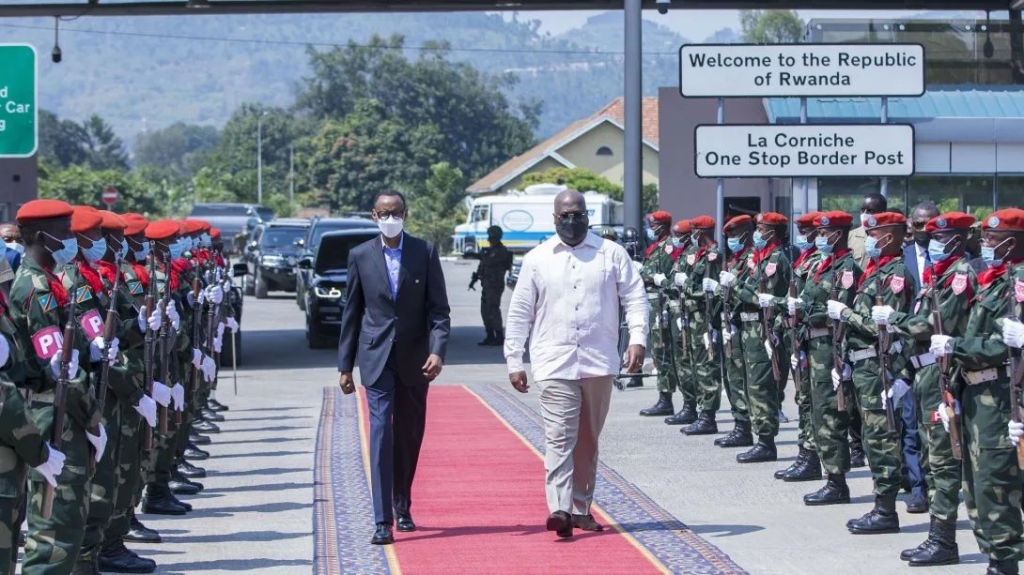
Image Source: https://cic.nyu.edu/
M23 emerged in 2012 when former members of the Congolese military rebelled, citing the government’s failure to honor a 2009 peace deal. This agreement promised M23 members integration into the Congolese army and protection from Hutu militias operating in the region. However, after repeated violations, M23 took up arms again in 2021, and now in 2025, they have intensified their campaign. The DRC government and the United Nations accuse Rwanda of backing M23. The motivations behind Rwanda’s involvement appear to be twofold: security concerns and economic interests. After the 1994 Rwandan Genocide, many Hutu extremists fled to eastern DRC, forming militia groups like the Democratic Forces for the Liberation of Rwanda (FDLR). Rwanda has long justified its military interventions in the DRC as efforts to neutralize these threats. The DRC holds an estimated $24 trillion in untapped mineral wealth, including gold, coltan, and tin—critical components for electronics manufacturing. Reports indicate that Rwanda benefits economically from illegal mineral exports, making its presence in the region highly strategic.
To fully understand the conflict, one must examine its historical roots. Colonial-era divisions, particularly those imposed by Belgian and German colonizers, fostered long-standing ethnic tensions between Hutus and Tutsis. These divisions fueled the Rwandan Genocide and subsequent cross-border conflicts, with the DRC often serving as a battleground for regional power struggles. Under President Paul Kagame, Rwanda has positioned itself as a dominant military force in Central Africa. By supporting M23, Rwanda extends its influence over North and South Kivu, ensuring a direct stake in the region’s lucrative resources and geopolitical landscape. The resurgence of M23 and Rwanda’s alleged involvement have sparked a diplomatic crisis. South Africa and Angola have deployed troops to the DRC, and in January 2025, 13 South African soldiers were killed in clashes with M23. If this pattern continues, the conflict could escalate into a full-scale regional war, drawing in multiple African nations and complicating diplomatic resolutions.
Over 700 deaths have been recorded in the recent fighting in Goma, highlighting the severe humanitarian toll. January 27, 2025, marks the day M23 seized Goma, a key turning point in the conflict. The 1994 Rwandan Genocide set the stage for the current tensions, while 2012 and 2021 witnessed major resurgences of M23, showcasing the recurring cycle of violence. The DRC remains one of the most resource-rich yet unstable regions in the world, with an estimated $24 trillion in untapped minerals. If diplomatic efforts fail, the DRC could see prolonged violence with devastating humanitarian consequences. The African Union (AU) faces immense pressure to mediate a resolution before militarization overtakes diplomacy. The global community must also recognize the economic motivations behind the conflict and work toward equitable solutions that ensure regional stability.
The crisis in the DRC is more than just an ethnic conflict—it is a battle over security, regional power, and economic dominance. Rwanda’s alleged backing of M23 is driven by both historical grievances and strategic interests in the mineral-rich Kivu region. Without immediate diplomatic intervention, this conflict could spiral into a regional war with far-reaching consequences. How should the international community respond to this escalating crisis? Could diplomatic intervention bring peace, or is military engagement inevitable? Share your thoughts in the comments below.
 BRYMO'S TAKE
Leave a comment