
To understand why Liberia’s civil wars burned so fiercely and so long, one must look beyond the three principal warlords and examine the forces they manipulated. Ethnicity, though only one facet of identity, became the organizing grammar of violence after 1980. Samuel Doe’s rise marked the first time a non-Americo-Liberian held power, yet rather than broadening inclusion he narrowed it, elevating his Krahn kin to crucial commands and branding Gio and Mano officers as potential traitors. Informal purges and selective promotions convinced many northerners that survival depended on overthrowing Doe. When Charles Taylor’s columns rolled into Nimba, villages delivered recruits not merely out of political sympathy but because the NPFL promised to reverse years of humiliation.
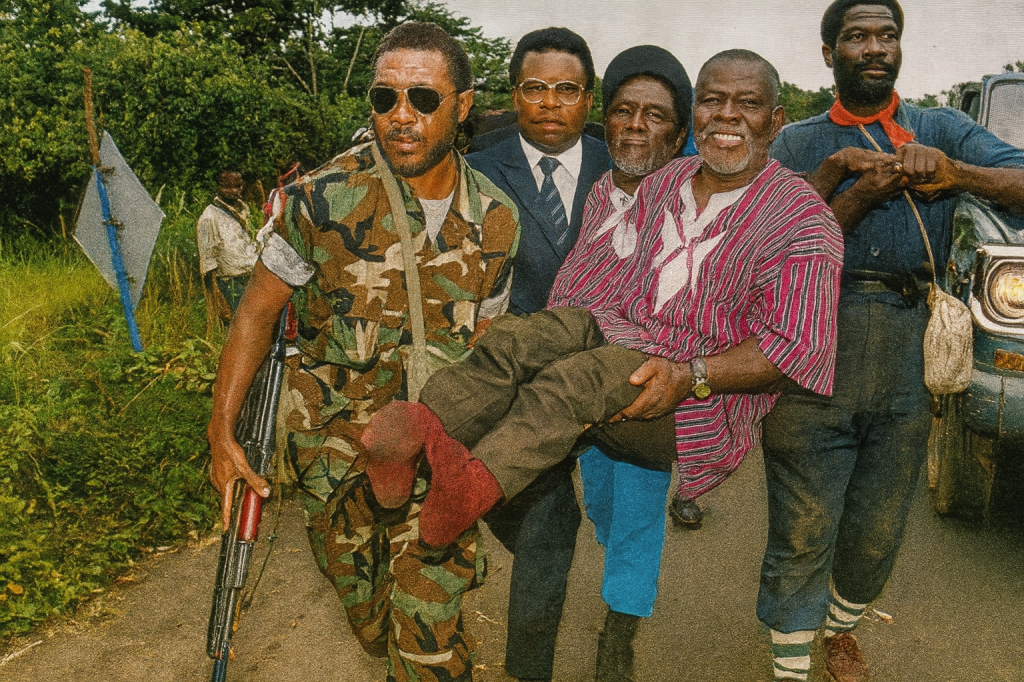
Taylor exploited those grievances with cynical brilliance. In video-taped rallies he vowed justice for Gio and Mano “brothers,” while quietly assuring French loggers and Lebanese merchants that their concessions would continue so long as his personal accounts were filled. Ethnic mobilisation eased the logistics of war—food, porters, local guides—yet the ultimate calculation was economic. Taylor’s fighters guarded rubber plantations one day and harvested ferrochrome the next, the profits wired through back-channels to purchase bullets or to pay for whisky-soaked nights in Abidjan hotels.
Prince Johnson mirrored the strategy, mobilising Gio identity to justify his split from Taylor. By painting Taylor as greedy and dictatorial, Johnson secured donors within the Gio diaspora who smuggled cash and ammunition across the Ivorian border. His theatrically brutal execution of President Doe in 1990, filmed as trophy footage, fused personal revenge with communal catharsis. The tape also institutionalised terror as political currency: commanders who demonstrated ruthlessness attracted recruits convinced that only cruelty could guarantee victory.
Religion offered moments of respite but rarely dictated front-line realities. Christian pastors and Muslim imams alike sheltered civilians, issued joint communiqués demanding cease-fires, and escorted orphans through checkpoints. Still, some fighters wore crosses, others crescent earrings, and all carried juju pouches—proof that, in the chaos, spiritual security had become portable and syncretic. When the guns finally fell silent, it was church basements and mosque courtyards that hosted the first trauma-healing circles, sewing seeds of forgiveness long before formal tribunals convened.
Self-interest among commanders metastasised into a war economy that thrived on predation. Timber from Grand Gedeh moved through Ivorian ports under forged waybills; diamonds from Lofa crossed into Guinea where customs officers, themselves unpaid for months, asked no questions. International sanctions only shifted trade into darker alleys. By 1994 a Kalashnikov cost the same as a bag of rice; control of a bridge meant customs revenue for whichever commander manned the sandbags. Warfare became entrepreneurship with an AK-47.
Neighboring states alternated between arsonists and firefighters. Félix Houphouët-Boigny of Côte d’Ivoire welcomed Taylor partly from Gola ethnic camaraderie, partly to check Guinean influence and secure cheap lumber. President Lansana Conté of Guinea later armed ULIMO rebels to hobble Taylor, prompting Taylor to bankroll cross-border raids that set Guinean villages ablaze. Sierra Leone suffered most: Taylor exchanged training and guns for RUF diamonds, exporting the Liberian template of amputations and terror. Nigeria, Ghana, Gambia and others assembled ECOMOG peacekeepers, an unprecedented West African gamble at collective security. Their battalions prevented Taylor from storming downtown Monrovia in 1990, yet accusations of looting and partiality dogged them throughout. The refugee tide—one million Liberians at its peak—strained already-fragile health systems from Danané to Conakry.
When the second Liberian war erupted in 1999, it did so amid a saturated landscape of loose weapons, mercenary networks and war-profiteers forged during the first round. LURD rebels recruited Mandingo and Krahn fighters from refugee camps in Guinea; MODEL rebels sprang from Ivorian borderlands. Both relied on the same diamond-for-guns pipelines Taylor had perfected. Regional fatigue, U.N. embargoes, and a U.S. amphibious show-of-force off Monrovia finally forced Taylor into exile in 2003, but only after West Africa had endured fourteen years of progressive unravelling.
Today, Liberia’s constitution enshrines the right of every ethnic group to equal participation, yet reconciliation remains a work in progress. Former child soldiers now in their thirties still talk of “our side” and “their side,” while unemployment nudges them toward the temptation of a quick payout from gold-camp militias over the border. The warlords’ fortunes, once measured in blood diamonds and teak logs, have faded; yet the war economy’s habits—bribery, impunity, zero-sum politics—linger in bureaucratic corridors and police checkpoints.
Liberia’s civil wars thus offer a cautionary chronicle: when ethnic grievances meet unbridled personal greed, when neighbouring states play double games, and when the international community mistakes a cease-fire for a cure, cycles of violence become self-financing. Breaking them demands more than ballots and peace accords; it requires dismantling the economic engines of conflict, securing regional borders against opportunistic meddling, and nurturing the quiet labour of religious and civic groups who, even at the war’s darkest hours, kept a fractured nation tethered to the notion that coexistence was still possible.
 BRYMO'S TAKE
Leave a comment