
The Ife and Benin Bronzes are among Africa’s most iconic artistic legacies, each testifying to the exceptional craftsmanship and deep cultural values of their African creators. Although both emerged from neighboring regions in present-day Nigeria, their artistic styles, historical trajectories, and global recognition have followed markedly different paths.
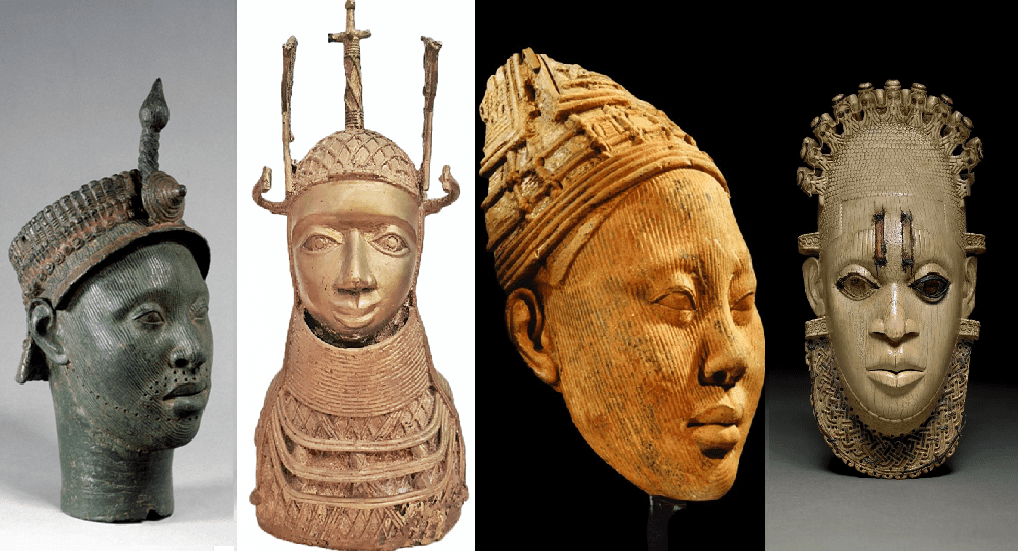
The bronzes from the ancient Yoruba city of Ife—often dated between the 11th and 15th centuries—are renowned for their lifelike naturalism. Sculpted from brass, copper, or terracotta, these pieces include serene human heads, full-bodied figures, and ritual objects. What astonishes many is their realism: the subtle facial features, intricate hairstyles, and anatomical precision led some early European scholars to wrongly attribute them to classical Greek influences. Today, they stand as powerful evidence of a sophisticated indigenous tradition that existed centuries before European contact. Many of these works are believed to represent royal ancestors and deified kings, connecting the living ruler—the Ooni of Ife, who is revered as the spiritual head of the Yoruba people—with the divine heritage of the kingdom.
In contrast, the Benin Bronzes—produced from the 13th century onward in the Edo-speaking Kingdom of Benin—are distinguished by their stylized depictions of royal court life. These artifacts, which include plaques, commemorative heads, and ritual vessels, were typically cast in brass or bronze using the lost-wax method. They adorned the walls and altars of the royal palace in Benin City and functioned as a historical archive, commemorating the power and lineage of the Oba (king). Some plaques even depict Portuguese traders, reflecting Benin’s early contact with Europe as far back as the 15th century.
While both traditions used similar metalworking techniques and materials, their artistic expressions diverged. Ife’s works leaned toward realism and spiritual introspection, whereas Benin’s art emphasized hierarchy, symbolism, and political authority. This distinction is not merely stylistic; it reflects different worldviews and functions within their respective societies.
The question often arises: why are the Benin Bronzes the focus of so much restitution activity from Western museums, while the Ife Bronzes remain largely out of the spotlight? The answer lies in the manner and history of their removal.
In 1897, during the infamous British Punitive Expedition, British forces invaded and sacked Benin City in retaliation for an earlier ambush. They looted thousands of objects from the royal palace and shipped them to Britain. The theft was meticulously documented—by soldiers, colonial officials, and journalists—providing a clear historical record of how these artifacts were taken. Today, this clarity of provenance has become a key factor driving global efforts to return the Benin Bronzes to Nigeria.
The Ife Bronzes, by contrast, were not seized during a single event. Many entered Western collections during the colonial period through archaeological digs, missionary exchanges, or even outright purchase—albeit under the unequal power dynamics of colonial rule. This scattered acquisition history makes legal and diplomatic efforts for restitution more complex. While some Ife works reside in museums abroad, many are already housed in Nigerian institutions, such as the Ife Museum and the National Museum in Lagos.
Another reason for the disparity is visibility. The Benin Bronzes have come to symbolize the broader issue of colonial plunder and cultural restitution. They are frequently cited in media, museum debates, and international campaigns, often serving as the face of global repatriation efforts. The Oba of Benin and the Edo State government in Nigeria have also mounted an organized push for their return, backed by plans for a Royal Museum in Benin City. In contrast, advocacy for the return of Ife artifacts has been more diffuse and lower in profile. Although the Ooni of Ife commands significant respect and holds deep cultural authority among the Yoruba, efforts tied to the restitution of Ife artifacts have not yet galvanized coordinated international campaigns.
Despite these differences, both traditions deserve equal recognition and protection. Their existence disproves outdated colonial assumptions that African societies lacked complex cultures or artistic sophistication. As technology and provenance research improve, and as African institutions grow in capacity and coordination, the hope is that greater attention will be paid to the Ife Bronzes and other equally deserving cultural treasures.
In the end, both Ife and Benin Bronzes stand as enduring testaments to Africa’s historical brilliance. Their stories—how they were made, what they mean, and where they ended up—form part of a larger conversation about identity, heritage, and justice. Returning them is not just about objects, but about restoring dignity and rewriting history on fairer terms.
References
Table 1: Two Sacred Cities, Two Distinct Traditions
| Kingdom of Ife | Kingdom of Benin | |
|---|---|---|
| People / Ruler | Yoruba – O̩o̩ni | Edo – Oba |
| Modern Location | Ile-Ife, Osun State | Benin City, Edo State |
| Flourishing Era | c. 11th – 15th c. CE | c. 13th – 19th c. CE |
| Core Function | Royal & ritual portraiture; shrine objects | Palace plaques, royal heads, court regalia |
| Stylistic Hallmark | Hyper-naturalistic faces with fine striations | Hieratic scenes, rich symbolism, hierarchical scale |
Table 2: How They Left Africa—and Why Only One Set Is Coming Home Fast
| Ife Bronzes | Benin Bronzes | |
|---|---|---|
| Removal Path | Piecemeal sales, colonial-era digs (1910s–30s), missionary markets | Mass seizure during the 1897 British Punitive Expedition |
| Provenance Clarity | Fragmented; often “legal” within colonial law | Single, well-documented act of war & plunder |
| Advocacy | Smaller, dispersed, less coordinated | Oba’s palace, Edo State govt., global campaigns |
| Restitution to-date | Rare; isolated claims | Accelerating: Germany (2022), Smithsonian (2023), Netherlands (119 objects, June 2025) (government.nl, theartnewspaper.com, apnews.com) |
 BRYMO'S TAKE
Leave a comment