
When South Sudan gained independence in 2011, it was heralded as a triumph for self-determination and peace. Over 98% of its people voted for sovereignty, hoping to forge a brighter, peaceful future after decades of brutal civil wars with the North. Yet today, South Sudan stands as one of the world’s most fragile states, gripped by ethnic violence, political power struggles, humanitarian disasters, and shattered dreams.
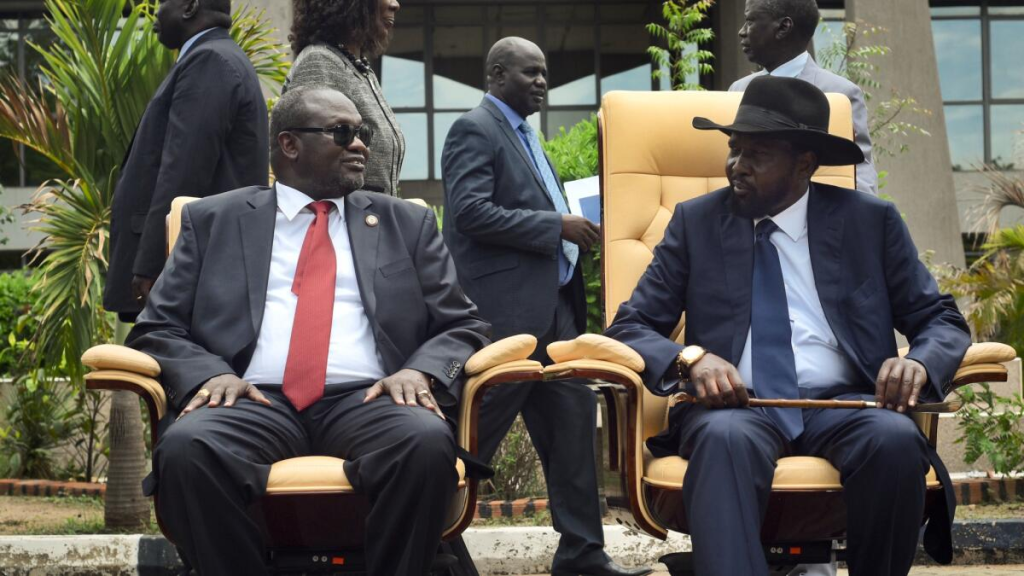
Riek Machar, left, South Sudan’s first vice president, and President Salva Kiir, right. (Image Source: Los Angeles Times)
Birth of a Nation — And Immediate Cracks
South Sudan’s independence was a rare beacon of hope in a world riddled with conflict. However, deep-rooted problems quickly surfaced. The country’s governance structures were weak, ethnic tensions between the Dinka and Nuer tribes simmered beneath the surface, and economic dependency on oil left the young nation vulnerable.
The political landscape was dominated by President Salva Kiir, from the Dinka ethnic group, and Vice President Riek Machar, a Nuer. Their uneasy alliance would soon spiral into deadly rivalry.
Historic Roots of Division
To understand South Sudan’s turmoil, one must look back at its history. Since 1956, Sudan had been plagued by colonial legacies, Arab dominance from the North, and two lengthy civil wars. These conflicts entrenched mistrust between communities and laid the foundation for today’s fractures.
The ideological split in 1991, known as the Nasir Declaration, saw Machar break from the Sudan People’s Liberation Army (SPLA), leading to the Bor Massacre, a tragic event that left deep wounds between the Nuer and Dinka.
From Independence to Civil War
Despite the 2005 peace agreement with the North, which paved the way for independence, internal divisions re-emerged. By 2013, a political rivalry between Kiir and Machar triggered a full-blown civil war. What started as a political dispute quickly devolved into ethnic violence, displacing millions and killing an estimated 400,000 people.
The conflict drew in neighboring countries like Uganda and global powers, who attempted to mediate peace. China, the United Nations, and regional organizations deployed peacekeepers, but the interventions yielded only fragile truces.
A Fragile Peace Deal on Life Support
In 2018, a Revitalized Peace Agreement was signed, offering new hope. Yet, implementation has been slow and flawed. Critical milestones — like forming a unified army, constitutional reforms, and ensuring political inclusivity — remain unfulfilled. Experts liken the peace deal to a patient in the Intensive Care Unit (ICU): alive, but critically weak.
Political distrust, sporadic violence, and weak institutions continue to threaten the deal. Machar has been placed under house arrest multiple times, and fighting between government forces and the White Army (Nuer-aligned militia) persists.
Regional leaders, including Uganda’s President, have pushed for de-escalation, fearing a return to full-scale war.
Humanitarian Catastrophe
The civil war and ensuing instability have created a catastrophic humanitarian crisis:
- 2 million internally displaced people struggle to survive in makeshift camps.
- 2.28 million South Sudanese refugees have fled to neighboring countries.
- Over 50% of the population faces acute food insecurity.
- The collapse of aid networks in conflict areas forces communities to self-organize for survival under brutal conditions.
Desperate civilians embark on perilous journeys to safety, often facing extortion, violence, and disease. In one poignant story, a woman gives birth on a roadside during her escape, naming her daughter “Nyle Off” — meaning “on the road” — symbolizing resilience amidst despair.
The Cycle of Violence
Ethnic militias like the White Army, formed primarily from Nuer youth, defend their communities against Dinka-dominated government forces. Towns are systematically looted, and each attack fuels retaliations, perpetuating an endless cycle of violence and revenge.
The inability of the government to protect civilians, deliver services, or hold perpetrators accountable only deepens grievances.
The Role of the African Union and Regional Powers
Recognizing the need for sustainable peace, the African Union (AU) Panel of the Wise has intervened, emphasizing dialogue and peaceful resolution. However, political will remains weak, and enforcement mechanisms are lacking.
Regional players like Uganda are increasingly entangled in South Sudan’s conflicts, providing military support that can either stabilize or escalate tensions.
A Nation at the Crossroads
South Sudan stands at a critical juncture. Elections are tentatively scheduled for 2026, but without significant reforms and reconciliation, they risk igniting further violence.
Civil society leaders advocate for broader political inclusion, beyond the narrow elite of Kiir and Machar, to build lasting peace. International actors are urged to move beyond listening to political rhetoric and engage directly with grassroots communities.
Despite immense suffering, hope persists. Refugees crossing into Ethiopia and elsewhere still dream of a peaceful homeland where their children can learn, live, and thrive.
Conclusion
South Sudan’s tragic story is a stark reminder that independence is only the beginning of nation-building. Without inclusive governance, trust-building, and strong institutions, the dream of freedom can quickly descend into a nightmare.
Yet amid despair, there remains a glimmer of hope. By learning from past mistakes, embracing inclusive politics, strengthening institutions, and fostering genuine reconciliation, South Sudan can still fulfill the promise that so many fought and died for.
The road ahead is long and perilous — but it is not impossible.
 BRYMO'S TAKE
Leave a comment