
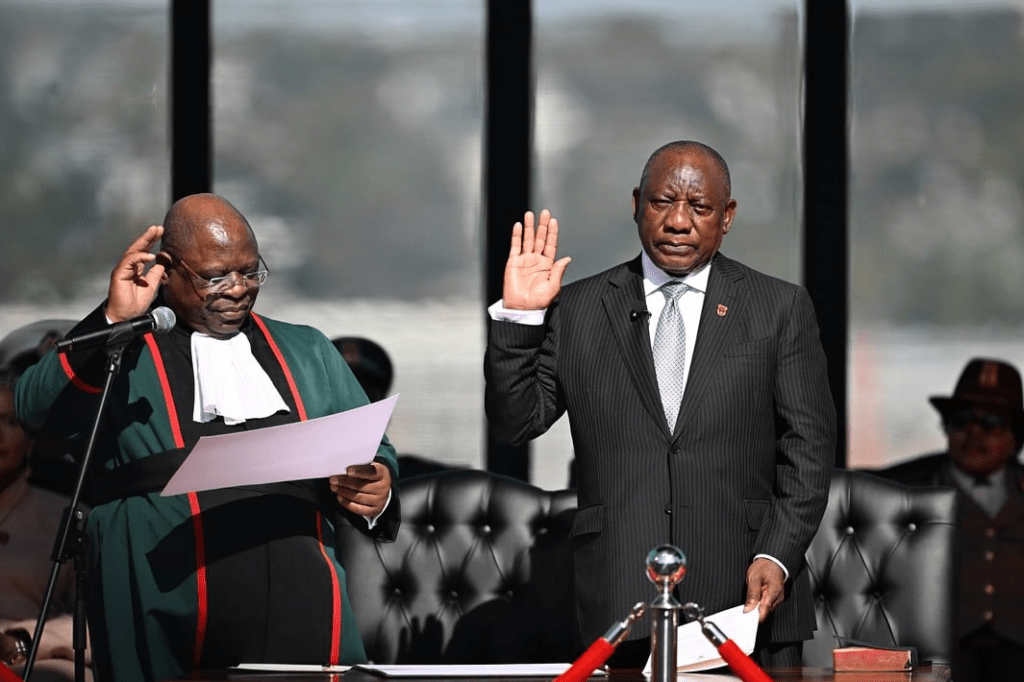
Yesterday, 19th June 2024, Cyril Ramaphosa was sworn in once again as President of South Africa, but this time under a unique political landscape. For the first time in the nation’s democratic history, the African National Congress (ANC), Democratic Alliance (DA), and Inkatha Freedom Party (IFP) have formed a coalition government. This unprecedented alliance marks a significant shift in the country’s political dynamics, with wide-ranging implications for governance, policy, and the socio-economic trajectory of South Africa.
The coalition’s primary promise is to bring stability to South African politics. Political instability has plagued the country, with infighting within the ANC and between opposition parties hindering effective governance. A unified government can potentially ensure more consistent and decisive policy-making, reducing the uncertainties that have deterred investment and economic growth.
One of the critical areas where this coalition could make a significant impact is economic policy. South Africa’s economy has been struggling with high unemployment, slow growth, and widespread inequality. A collaborative approach between the ANC’s focus on social welfare, the DA’s emphasis on market-driven policies, and the IFP’s regional economic strategies could foster comprehensive reforms. These might include job creation initiatives through support for small and medium enterprises (SMEs) and infrastructure investments, stringent fiscal policies to curb corruption, and creating a more favorable investment environment through regulatory reforms and incentives.
The coalition also holds promise for improving social cohesion in a country still deeply divided along racial and economic lines. By working together, these parties can address issues of inequality and promote inclusive development. This includes ensuring equitable access to quality education, expanding healthcare services, particularly in underserved rural areas, and strengthening local governance to build trust among diverse communities.
This coalition presents an opportunity for innovative policy experiments that combine the strengths of each party. For instance, the DA’s track record in municipal governance can be scaled to the national level, while the ANC’s experience in social programs can be enhanced with input from the IFP’s community-based approaches.
While the coalition brings hope, it is not without challenges. Managing differing ideologies and policy priorities within the coalition will require exceptional negotiation and compromise skills. Maintaining unity and avoiding factionalism will be crucial to sustaining the coalition’s effectiveness. Potential points of contention include balancing the ANC’s push for land expropriation without compensation with the DA’s property rights stance, reconciling sustainable energy solutions with the economic realities of coal-dependent regions, and ensuring rigorous anti-corruption measures that may expose members from all parties.
The coalition between the ANC, DA, and IFP under the leadership of Cyril Ramaphosa marks a significant and potentially transformative moment in South Africa’s history. If managed effectively, this alliance can address longstanding issues, promote economic recovery, and enhance social cohesion. However, it will require continuous commitment to collaboration, transparency, and a shared vision for the country’s future. As South Africa steps into this new political era, the world watches closely, hopeful for a prosperous and united nation.
 BRYMO'S TAKE
Leave a comment